Tuesday, August 9, 2016

BARREL Status Report #6 August 9, 2016

BARREL Status Report #6
August 9, 2016

The upper level wind speeds are still too high so we are definitely not launching tomorrow. The good news is that the predictions show the speeds starting to come down in the next few days. It looks like we are starting to enter turnaround! At this point, we are planning for a Saturday evening launch in order to catch the Van Allen Probes conjunction on Sunday morning. The weather looks marginal at this point but we’ll keep looking at it. Today we finished the CPT for payload 2G and balanced the payload with its flight train. We also got payload 1Z checked out and plan to button it up and do its CPT tomorrow.  Tomorrow we should have some dry weather so will have an opportunity to do a launch dry run with Esrange personnel. 

Robyn, 


And now some of the first photos from the team in ESRANGE! Photos are always exciting :) 


Testing systems/communications. We have to take the payloads outside in order to have them connect with the iridium satellites and to make sure there is no interference with the ESRANGE systems. Better to find out now on the ground if they are having trouble instead of when we fly them. But all systems are good to go. Now just hoping for good ground weather, slow stratospheric winds, and some interesting space weather to view! 


This is from the hang test. We want to make sure the payload weight distribution is balanced so its more stable which provides more stability when flying, a hopefully more controlled decent and thus softer landing, and everything should be sitting up nice a straight in the box. Looks pretty straight to me :) 

BARREL Daily update Aug. 9th 2016

Hej och god morgon (Hi and good morning), 

Update Summary

Important news about MMS. MMS has extended their burst collection region to include that of the BARREL locations. However, this also includes everything at higher L-values as well I believe. If you have say a magnetometer array, or riometer or a satellite that has seen something interesting in this region please contact them (Allison Jaynes or Drew Turner) within ~24 hours so that they can gather the data. 

Although we haven't yet had a CME, here's a fantastic tool to look at predicted arrival times. Different research groups will submit their modeled runs and predictions and then after the event has arrived (or missed us) a scoreboard is created to see which models captured which aspects of the solar event. http://kauai.ccmc.gsfc.nasa.gov/CMEscoreboard/ . (see below, but this may be very useful for the coming week, fingers crossed) These research models serve two purposes. 1st) as they are shown to be more and more accurate they can be turned into forecasting tools that NOAA and others use. 2nd) It helps us determine what physics we've got right, what we're missing, and how different modeling techniques affect the results and which ones are better for different processes ect. 

The stratospheric winds are  currently still very fast and westward which gives estimate flight times of only 1-3 hours if we were to launch tomorrow.  So, we are NOT going to attempt to launch tomorrow.  

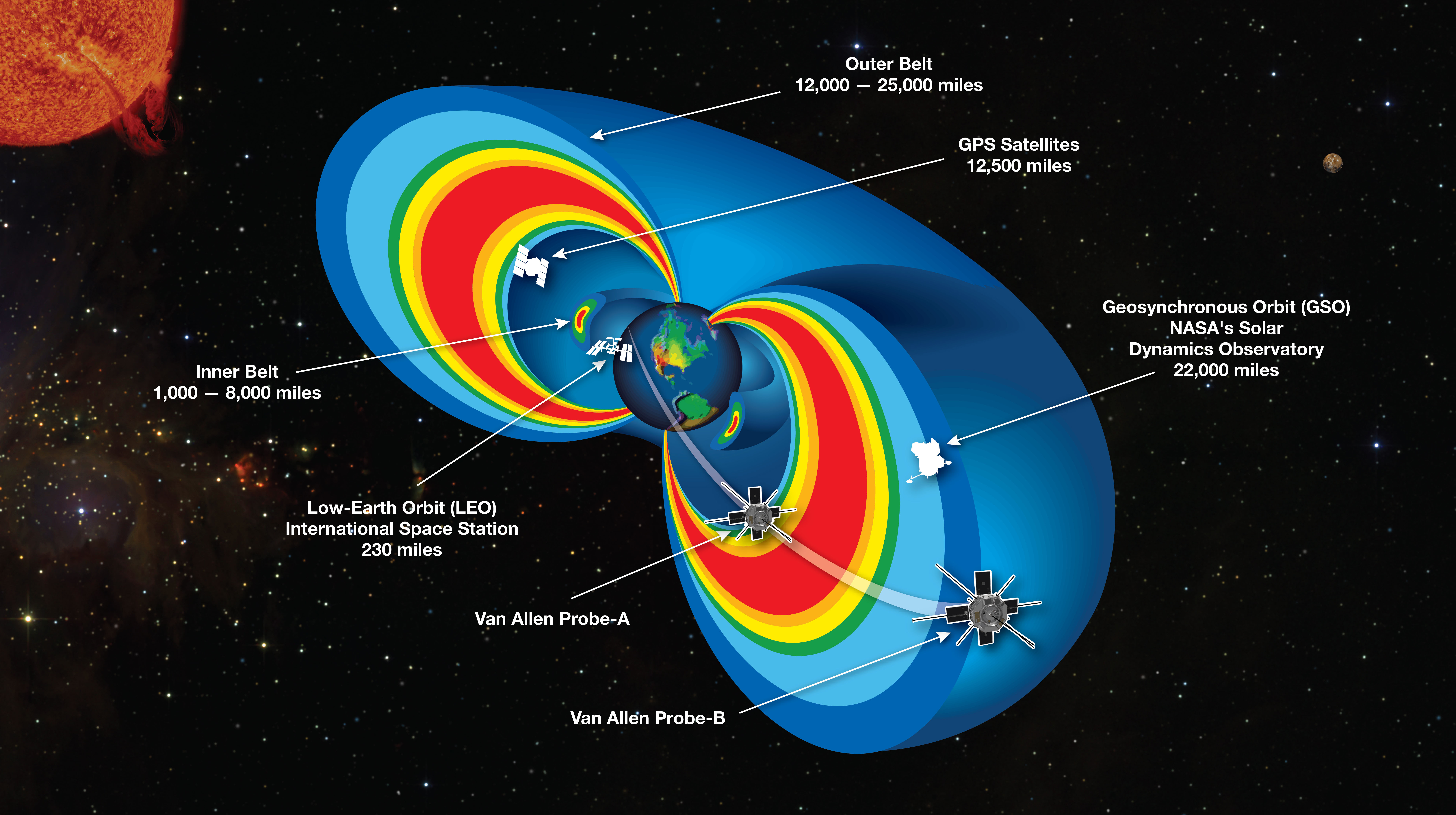
The good news is that the upper level wind predictions for a few days from now show that it is starting to change. So, we may soon be are entering turnaround in the next couple of days which would give us a first possible launch Saturday evening (Aug 14) in order to be up at float altitude for the conjunction with Van Allen Probes early in the morning on Aug. 15th. 

In talks with the CCMC crew, it sounds like there is likely going to be an active region which has the possibility of producing Earthward directed CME's coming around the Earthward side of the disk. If this region were to explode and produce such a CME, it would likely hit us in about a weeks time, so fingers crossed that we get some great space weather in time for the Sunday conjunction

News from Kiruna

Next possible launch date - Evening of Aug. 14th for the early morning conjunction on Aug. 15th

Payloads up:
none
Payloads coming/which came down:
none

News from Van Allen Probes:
Summary
The lapping event is happening I think tomorrow. (this is when the two spacecraft come very close together. Interesting science often comes out of these events. Specifically, we can see if the waves or particle populations observed at the spacecraft are the same or different. This allows us to determine the scale size, or how large the different regions are.)
News from MMS: 
MMS team needs to know within 24 hours if you would like them to download data. E-mail Drew Turner or Allison Jaynes if you would like them to collect data in a specific region/time for conjunction studies.  

Space Weather  from Spaceweather.com, SWPC.noaa.gov,  and Kyoto (possibly others as well)
May be an EMIC wave around noon but it's unclear if it's band limited or just part of the broad band waves. 

(EMIC waves are a type of wave that ends up affecting how quickly relativistic, or very high energy, electrons are lost into the Earth's upper atmosphere. This lost population of electrons produces X-rays which can be observed by the BARREL instrumentation as well as creates changes in the upper atmospheric chemistry.)

EMIC waves observed around noon at Kilpisjarvi, IVALO, and maybe a few others but they become incredibly faint. 

Just a reminder Riometers are not my area of expertise, but it does look like there may have been precipitation from around 15 UT - 23 UT yesterday. 

NOAA GOES Electron Flux:
Some activity but fairly nominal levels. 

NOAA GOES Proton Flux:
nominal levels.

ACE Solar wind speed: 
Vsw =  617.3 km/s

ACE Solar proton density:
density =  1.8 protons/cm^3

(High solar wind speeds, when combined with high densities can compress the Earth's magnetosphere and generate waves and ultimately loss of radiation belt particles to the Earth's atmosphere as well as loosing some of the radiation belt particles back out to space. When you then combine this with a strong southward Bz component (see below) you often get geomagnetic storms. When you have geomagnetic storms you often get aurora. The stronger the storm the further equator ward you are likely to see the aurora!) 

Sunspot number from SDO/HMI: 
91 and Sunspot AR2571 has a beta-gamma complexity which means that there is at a slightly higher chance for an M-class solar flare. Currently it looks like if we were so lucky for it to produce a CME, it may be Earth directed. There are a few more larger sunspot regions which are coming around the disk and may produce Earth directed CMEs in a few days giving a potential arrival time of about 1 week from now. This is all speculative at the moment but stay tuned! 

NOAA GOES Flare activity:
6-hr max C2 
24 hr max C8

NOAA/SWPC Kp:
kp =   3 with a 24 hour max of kp = 4

ACE SW magnetic field:
Bz = 4.3 nT South
Btotal =  5.6 nT

ESA/NASA/SOHO Coronal hole news
The high speed stream has reached the Earth and the solar wind velocity is expected to stay high until about August 12th according to the WSA-ENLIL models housed at SWP NOAA. However, if Bz continues to fluctuate we may not expect a geomagnetic storm associated with the HSS. Hopefully though we'll get some nice substorm activity. 

Realtime Kyoto AE:
Possibly substorm around 4:00UT and 9:30 UT today. 

Realtime Kyoto Dst:
Very quiet. 

Min favoritämne i skolan är matte
My favorite subject in school is math. 

And because today's word is math, and we all love math, a few more 

enkel matematik
simple math

matematiskt problem
mathematics problem

Svara på matematiktalet
Answer the math problem

Hej då och god kväll från Kiruna (Good bye and good evening from Kiruna), 

BARREL Status Report #5 August 8, 2016

BARREL Status Report #5
August 8, 2016

This status report also covers the weekend. Payload 2G was buttoned up into flight configuration and taken outside for it’s CPT. We were interrupted by rain and it’s been raining on and off ever since! In the meantime, we’ve been doing additional ground station testing and payload 2J has been running inside continuously since Friday for a battery rundown test. We also did some launch training and reviewed the launch equipment. The UH students got their VLF instrument mounted onto payload 2U so it’s nearly ready to go through CPT as soon as we get some better weather. 

Today, we had our Flight Readiness Review with Esrange safety and operations. Later in the day we had our Flight Readiness Review with NASA. Both went smoothly, and we are ready to launch! We had our first weather briefing and, although the surface weather looks pretty good for Wednesday evening, the upper level winds are still moving too fast westward. We’ll be making a final decision at today’s weather briefing. The next conjunction with RBSP is Sunday morning, so we will most likely not have another launch attempt until Saturday night. I’ll keep you posted! 


***Update from Robyn: We will not be attempting to launch Wednesday evening, so we're looking forward to hopefully a chance to launch Saturday night. ****

Monday, August 8, 2016

BARREL Daily update: August 8th 2016

Hej och god morgon (Hi and good morning), 

Today is the start of the daily e-mails. Today we will have our telecom a bit early at 11 am Eastern (Dartmouth time). The call in info is below. 


Update Summary

The link to the wind map which was discussed last telecom is here https://earth.nullschool.net/#2015/08/05/0600Z/wind/isobaric/10hPa/orthographic=20.80,64.85,3000/loc=11.611,65.655 but we should be getting wind maps and updates on the winds at our expected float altitude starting today or tomorrow from Kiruna. 

This year we're also working with the CCMC to get a better idea about possible incoming space weather. (We already use a ton of info from NOAA's Space Weather Prediction center as you can see below, but the CCMC will give us just a bit more info for our decision making. Also they have a summer student who's interested in science communication and modeling/forecasting... NOAA, she may be a fantastic future hirer :) ) They have a bunch of publicly available tools, and in particular one where we could put together all the information normally included below in the space weather section onto one webpage. Once that link becomes live I'll send it out in the following e-mail. 
    
News from Kiruna
Payloads up:
none
Payloads coming/which came down:
none

Space Weather  from Spaceweather.com, SWPC.noaa.gov , http://relativisticballoons.blogspot.com/2016/08/space-weather-update.html,  and Kyoto (possibly others as well)

Kiruna Magnetometer:  http://www.irf.se/Observatory/?link=Magnetometers
It looks like there was a substorm last night, but no EMIC waves associated with it at this station. 
There was a nice EMIC wave at Kilpisjarvi but it was not seen at the other magnetometers in the array. 

Just a reminder Riometers are not my area of expertise, but it does look like there may have been precipitation associated with the substorm last night. 

GOES Electron Flux:
GOES 800 keV and 2 MeV electrons appear to have been disturbed and dropped out for a short time with the substorm activity possibly but appear to be recovered as of sending this e-mail. 

GOES Proton Flux:
nominal levels.

Solar wind speed: 
Vsw =  489.9 km/s

Solar proton density:
density =  3.9 protons/cm^3

Sunspot number:
63 and Sunspot AR2571 has a beta-gamma complexity which means that there is at a slightly higher chance for an M-class solar flare. Currently it looks like if we were so lucky for it to produce a CME, it may be Earth directed. However the chances of it flaring are low (see Anna's post on the blog). 

Flare activity:
6-hr max C5 
24 hr max C5
(Should also note that Anna the CCMC summer student has been working on a flare prediction model! )

Kp:
kp =   2 with a 24 hour max of kp = 4

SW magnetic field:
Bz = 2.9 nT north
Btotal =  4.8 nT

Coronal hole news
A coronal hole with a nice high speed stream should hit today or maybe tomorrow. It does look to be quiet wide so we may see high solar wind speeds for quite a while. We've got our summer CCMC student working on looking at what this high speed stream looked like at Stereo A which may give us an indication of the magnetic field orientation associated with it. 

AE:
Possibly substorm around 00 UT this morning. 

Dst:
quiet. 

Daily BARREL check in information: No Telecon today. 
Two hours earlier on Monday Aug. 8th 5pm Kiruna time (11:00 Dartmouth time, 10:00 Minneapolis/Iowa time, 9:00 University of Colorado Boulder, 8:00 Berkley time)
(normally Time: 7pm Kiruna time (13:00 Dartmouth time, 12:00 Minneapolis/Iowa time, 11:00 University of Colorado Boulder, 10:00 Berkley time)) . 

Phone number +1 641-715-3580
Access code 481960

Den unga flickan gillar inte broccoli
The young girl dislikes broccoli

Hej då och god kväll från Kiruna (Good bye and good evening from Kiruna), 

Alexa and the BARREL team. 

Sunday, August 7, 2016

Space Weather Update

Yesterday’s enhanced solar wind velocity at Earth (from a high speed stream) caused the  >0.8 MeV energetic electron flux to cross the threshold of 10^5 pfu (particle flux units). It crossed at 2016-08-06T13:30Z and rose to 120000 pfu. Electron flux offers information about the state of the Earth’s outer radiation belt.

Credit: NASA

Current electron flux levels are below threshold but still enhanced ( >80000 pfu).

Today there has been 5 flares of C1.0 or above, one of which was an M1.3 flare, peaking at 14:44Z. As of yet, no resulting Earth-directed CMEs have been observed.

MAG4’s full-disk 24-hour solar flare probability outlook predicts a 2% chance of M/X class flares. ASAP's 24-hour solar flare probability outlook predicts a 6% chance of M-class flares from NOAA active region 2571 (with a 1% chance of X-class), and a 2% chance of M-class flares from the 2570/2572 active region complex (with a 1% chance of X-class).

Today’s KP <= 4. We are not currently expecting any strong KP enhancements from Earth-directed CMEs, however, it is likely that the high speed stream that arrived at STEREO A at 2016-08-04T02:00Z will also impact Earth. It’s anticipated arrival at Earth is predicted for the morning of August 14 (2016-08-14T09:12Z).

Credit: Barbara Thompson/ iswa.gsfc.nasa.gov
Above is an image of the coronal hole that caused the high speed stream at STEREO A. The prediction for when the high speed stream will arrive at Earth was determined by calculating the number of days it will take for the sun to rotate to the point where this coronal hole is facing Earth and in the correct position for the high speed stream to travel towards our planet.


Saturday, August 6, 2016

Introductions: Arol Johnson

Today we introduce Arlo Johnson. Welcome to the team Arlo! 


Arlo Johnson is a graduate student at Montana State University working with Dr. John Sample. He got his bachelor’s degree in physics at the University of Montana in 2010, and his master’s degree at Montana State in 2012. Arlo began his physics studies in solid state materials science, but outside of school he was always thinking and reading about space. Because of this he switched his focus to space science when he became involved in the FIREBIRD satellite project in the fall of 2015, and joined the BARREL team last winter. His research is focused on combining the observations of these two projects. Space has always fascinated Arlo, and becoming a space scientist is a childhood dream come true.

BARREL Status Report #4: August 5th 2016

BARREL Status Report #4
August 5, 2016

Here’s a short recap of BARREL progress today. This morning, we completed a compatibility test with Esrange and everything went smoothly. We exercised commands on both systems and we looked for any interference issues. We didn’t expect any problems since everything flew together last year, but it was good to confirm! After lunch, we got Payload 2S buttoned up and outside for a CPT. Then we did the initial checkout and instrument integration on Payload 2G. The University of Houston team arrived this afternoon. We are again flying their TEC and VLF instruments as student piggyback experiments this year. They are funded by the USIP program (Gar Bering is the PI). Finally, we had our first burst telecon with teams from Van Allen Probes, FIREBIRD, ABOVE2, and Lomonosov satellite to discuss coordination and planning for conjunctions.  

This weekend, we’ll review the launch equipment and procedures with BARREL team members so we’ll be ready for a launch dry run with Esrange on Monday. 

Have a great weekend!

Robyn