Showing posts with label photos. Show all posts

Thursday, August 18, 2016

BARREL Status Report #12 August 17, 2016

BARREL Status Report #12
August 17, 2016

BARREL Flight 4B was terminated this morning at 0350 UT. The balloon started with a nice southerly trajectory, so we thought we might get a long flight out of it. But, it took a sharp turn to the west right after sunrise and had to be cut down as it approached the mountains. Despite the relatively short flight, we caught all of the RBSP conjunction we were targeting, and even had some substorm activity. We saw a very bright relativistic precipitation event which may have been associated with that substorm. The payload was recovered in very good shape earlier today. Note that this payload was also carrying the Univ. of Houston TEC experiment. We’re excited to see if they saw any change in total electron content due to the energetic precipitation! 

The Van Allen Probes EFW team is now requesting playback of burst data from our first flight and they are planning data collections for the next conjunctions. We will not be launching on Thursday due to the predicted flight trajectory (climb out is mostly west which shortens the flight substantially). So, the next launch attempt is likely to be on Friday. I’ll send another update then. 


Robyn


NASA's BARREL Mission in Sweden

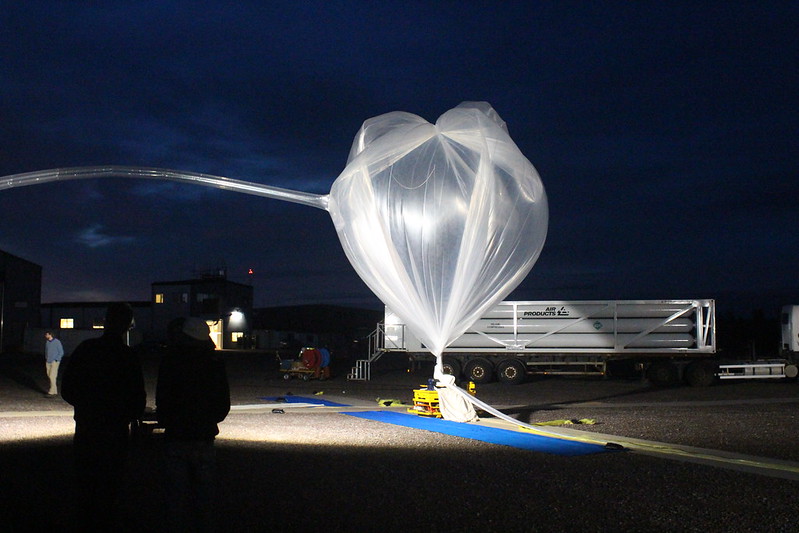
A BARREL team member recovers the second payload after it landed. 
 
The BARREL team is at Esrange Space Center near Kiruna, Sweden, launching a series of six scientific payloads on miniature scientific balloons. The NASA-funded BARREL – which stands for Balloon Array for Radiation-belt Relativistic Electron Losses – primarily measures X-rays in Earth’s atmosphere near the North and South Poles. These X-rays are produced by electrons raining down into the atmosphere from two giant swaths of radiation that surround Earth, called the Van Allen belts. Learning about the radiation near Earth helps us to better protect our satellites. 
 
Several of the BARREL balloons also carry instruments built by undergraduate students to measure the total electron content of Earth’s ionosphere, as well as the low-frequency electromagnetic waves that help to scatter electrons into Earth’s atmosphere. Though about 90 feet in diameter, the BARREL balloons are much smaller than standard football stadium-sized scientific balloons.
 
This is the fourth campaign for the BARREL mission. BARREL is led by Dartmouth College in Hanover, New Hampshire. The undergraduate student instrument team is led by the University of Houston and funded by the Undergraduate Student Instrument Project out of NASA’s Wallops Flight Facility. For more information on NASA’s scientific balloon program, visit: www.nasa.gov/scientificballoons. 
 
Image credit: NASA/Montana State University/Arlo Johnson

Wednesday, August 17, 2016

The NASA Goddard BARREL Flicker page is up and running!

A huge thanks to Sarah Frazier for creating this amazing flicker page for BARREL. You can see all of the photos as we gather them here.


Thanks so much Sarah and all the photographers in our Kiruna Crew!


NASA's BARREL Mission in Sweden

Tuesday, August 16, 2016

BARREL Status Report #11 August 16, 2016

BARREL Status Report #11
August 16, 2016

BARREL flight 4B (payload 2J) was launched about 30 minutes ago at 2002 UT, right on schedule. The balloon is now at float altitude, ~36 km. The upper level winds are still holding out at a higher than desired speed, so this may be another short flight. But we still have a good chance to catch most of the conjunction with Van Allen Probes. A picture of inflation, courtesy of Gar Bering from the University of Houston, is attached.

The ABOVE2 experiment led by Chris Cully from University of Calgary is also planning to attempt a launch from Saskatoon today. If they do launch, they will be in conjunction with Van Allen for the orbit following the BARREL conjunction so this could be very interesting. Fingers crossed!  

Best, 

Robyn 


Sunday, August 14, 2016

BARREL Status Report #10 August 14, 2016

BARREL Status Report #10
August 14, 2016

I’m happy to report that BARREL Flight 4A was a success! The balloon and payload both performed well. The flight was terminated at 0540 UT because it was moving west towards lakes and mountains. It was a short flight, but longer than we expected. Most importantly, we caught the conjunction with RBSP-A that we were targeting, and we saw a precipitation event that lasted almost two hours.  A preliminary look suggests that this was bursty, most likely microburst precipitation. We’ll need to look at the data more carefully, but this looks very promising. The payload is now on the ground at 67.72N, 18.88E, and recovery prospects look good. 

I think the team will be resting for most of the day today. We expect the next launch attempt to be on Tuesday. I will send another update when we get a better look at the surface weather.

Robyn

From Arlo 

We have recovered the payload from flight 4A! There was some light damage to the box and handles, but the payload seems intact upon initial inspection. The flight was about 5 hours at float, and recovery was smooth in an easy to reach, relatively dry area.


Saturday, August 13, 2016

BARREL Status Report #9 August 13, 2016 - First launch

BARREL Status Report #9
August 13, 2016

BARREL Flight 4A was launched from Esrange at 2224 UT on August 13. The payload is currently at about 5 km altitude and will take another ~1.5 hours to reach a float altitude of ~36 km. The flight is predicted to be somewhat short due to the upper level winds so the team held off in order to target the conjunction with Van Allen Probes. The next launch is likely to be Tuesday in order to target another conjunction. 

Robyn

See our twitter feed for some photos from the team on the ground of the launch. 

Here's one from Greg Bowers, a BARREL Grad student from University of California Santa Crux. 


BARREL Status Report #8 August 12, 2016

BARREL Status Report #8
August 12, 2016

The surface weather for Saturday looks promising so we are planning to show for launch at 1800 local. The upper level winds are still a bit westward but the speeds have come down substantially. The flight is likely to be on the shorter side but we think it will be long enough to catch the conjunction with Van Allen Probes early Sunday morning. I’ll send another update tomorrow.


Tuesday, August 9, 2016

BARREL Status Report #6 August 9, 2016

BARREL Status Report #6
August 9, 2016

The upper level wind speeds are still too high so we are definitely not launching tomorrow. The good news is that the predictions show the speeds starting to come down in the next few days. It looks like we are starting to enter turnaround! At this point, we are planning for a Saturday evening launch in order to catch the Van Allen Probes conjunction on Sunday morning. The weather looks marginal at this point but we’ll keep looking at it. Today we finished the CPT for payload 2G and balanced the payload with its flight train. We also got payload 1Z checked out and plan to button it up and do its CPT tomorrow.  Tomorrow we should have some dry weather so will have an opportunity to do a launch dry run with Esrange personnel. 

Robyn, 


And now some of the first photos from the team in ESRANGE! Photos are always exciting :) 


Testing systems/communications. We have to take the payloads outside in order to have them connect with the iridium satellites and to make sure there is no interference with the ESRANGE systems. Better to find out now on the ground if they are having trouble instead of when we fly them. But all systems are good to go. Now just hoping for good ground weather, slow stratospheric winds, and some interesting space weather to view! 


This is from the hang test. We want to make sure the payload weight distribution is balanced so its more stable which provides more stability when flying, a hopefully more controlled decent and thus softer landing, and everything should be sitting up nice a straight in the box. Looks pretty straight to me :) 

Thursday, August 4, 2016

BARREL Status Report #3, August 4, 2016

BARREL Status Report #3
August 4, 2016

It’s a beautiful evening in Kiruna. Today, we got a lot accomplished. We conducted a comprehensive performance test for our first payload (2J) and finished getting the second payload (2S) ready for its CPT. A third payload (2U) is checked out and ready to be buttoned up. We did a mechanical hang test with ESRANGE equipment to make sure everything fits together as it should.


We got a final mass on this payload (29 kg) and it comes pretty close to the launch mass from last year, which is comforting. We also set up our local GSE in the “Basilica” which is the building we’ll use for launch and termination operations. Tomorrow we plan to do a flight compatibility test with ESRANGE to makes sure everything checks out electrically. 

So far so good, and we are still on schedule for our flight readiness review on Monday! 

Robyn

Introductions: Michael Greer

Today we introduce Michael Greer. He's currently a mechanical engineering student at the University of Houston. He's currently a team member of the USIP II VLD IRIG-B instrument team as well as the software team leader. 

Michael Greer is an undergraduate engineering student studying at the University of Houston. From a young age, he was always interested in the space sciences and decided to become an engineer to contribute to the field of astronautics. During his junior year at the University of Houston, Michael became involved with the newly reformed UH chapter of the American Institute of Aeronautics and Astronautics (AIAA). As a member of the AIAA, he joined the chapter’s rocket design team and eventually went on to become the Vice President of the chapter. Through the AIAA, Michael learned about USIP and applied to join it. USIP offered an excellent opportunity to learn about the scientific research process and to be exposed to NASA related work. After joining the VLF/IRIG-B team in USIP, Michael focused on the engineering challenge of designing a digital circuit that generates an analog time code signal using the IRIG-B protocol.


In the future, Michael hopes to continue doing space related engineering and to eventually work with NASA or other aerospace organizations as a propulsion engineer. 

You can follow Michael throughout the campaign on twitter @MichaelLGreer 

Tuesday, August 2, 2016

BARREL Status Report #1 August 2, 2016

August 2, 2016

​Hello from Esrange in Sweden! The first installment of the BARREL team arrived Monday afternoon. Today we had our safety briefing and met with SSC personnel to review plans and make sure everything is in order. On the negative side, the bulk of our cargo got delayed by customs. We finally got it cleared last Thursday, but it’s still making it’s way from Stockholm to us. We know where it is and we’re told it will arrive tomorrow, so we should still be on schedule for a flight compatibility test on Friday. On the positive side, I guess we have a little time to rest after the long trip!

Schedule​:
Wed-Thurs: get first two payloads checked out and configured for flight
Friday: FCT with SSC equipment
Monday: Launch dry run and NASA Flight Readiness Review 11am eastern (by teleconference)

From now through the end of August, I will be sending status updates on most days. If anyone does NOT want to be on this email list, please let me know and I will remove you. If there is anyone who needs to be added, please let me know that also.

Here’s to a successful final BARREL campaign! 

Robyn

P.S. Our cheat sheet was still hanging up in our "office". Useful bits of information! 

Thursday, July 28, 2016

Introductions: Arian Ehteshami

Today we'll meet another of the Kiruna crew, Arian Ehteshami. Arian helped out in Kiruna last year as well with launching the balloons as well as helping out with two piggy back experiments from the University of Houston. He was the lead on the TEC experiment and helped out with the VLF experiment which flew twice last year.


Recently Arian graduated with a bachelor's of science in biomedical engineering-bielectrical concentration from the University of Houston. Currently he is a Mentor of USIP-II. Previous Lead on TEC experiment, member of Astrobiology experiment, and previous lead on VLF data processing tasks. His focus has primarily been in bioelectrical engineering which is composed of medical devices, optimizing biosignal filtration, brain machine interfaces and learning, biomarker detection. and biometrics. However, on the side Arian always had a strong passion for the space environment. The symbiotic relationship between humans and space habitats is a problem yet to be solved. By joining the USIP team back in 2014, Arian was able to understand many of the basics of atmospheric and plasma phenomenon’s and how to quantify them. USIP has changed his life for the better both academically and socially. It motivated him to help bring back the UH AIAA-student chapter after a eight year dormitory period, awarding him the AIAA award for student officer of the year. Currently, he is the CoFounder of a startup called OcuRhythm which was accepted into the UH Red Labs and Rice University OwlSpark startup accelerator program. He and his team are producing glasses that will help users shift their circadian rhythm by means of light therapy. These glasses have a learning mechanism that controls the lights based on the user’s own lifestyle. The root of this problem arose when Dr. Bering voiced the concern of astronauts and the state of sleep deprivation they experience. In the future, Arian hopes to be heavily involved with space medicine research that institutions such as NSBRI, Wyle, and NASA’s HRP are currently working on.


Welcome back Arian and we look forward to hearing from you during the campaign! You can follow Arian on twitter at @Aehtesha and the BARREL campaign at @keV_balloons

From Last year's campaign. @Aehtesha and @browncoat33 also known as Hamza.


Wednesday, July 27, 2016

Introductions: Edgar Andrew Bering III

This year we have a bunch of undergrads, and recent grads from the University of Houston helping out in Kiruna. They will also be taking on some of our twitter feed and posts. So we figured it might be a good idea to introduce them and say "Hi" and "welcome to the team". 

Today we introduce the ring leader :) Edgar (Gar for short) Andrew Bering the third, and yes that is his full actual name. He's a professor of physics and electrical and computer engineering at the University of Houston. He got a physics undergraduate degree from Harvard College in 1967 and his PhD in 1974 from University of California Berkeley. 


Dr. Bering joined University of Houston, in 1974, became an Assistant Professor in 1975, became a full professor in 1989 and received his present dual appointment in 1998. He has published 133 Refereed papers, 75 Technical Reports, 95 Invited Talks, and 364 other Abstracts. In 2000, he was a member of the VASIMR team that won the Rotary National Award for Space Achievement, Stellar Award, Team Category. In 2004, he received the AIAA Best Paper of the Year award in Plasmadynamics and Lasers. He has been involved in Education and Public Outreach since 1990. In 2005, he received a Special Service Award from AIAA for his work on the Mars Rover Model Competition outreach program. Thus his twitter handle @MarsRoverUH (and of course you can follow the BARREL campaign @keV_balloons). He is an Associate Fellow of the AIAA.

Dr. Bering created the annual Houston-wide UH Mars Rover model competition for budding engineers in grades 3-8 in 2002. From 2002 to 2005, this event experienced 40% per annum growth. As many as 720 students, 60+ teachers, 550 volunteers and 1000+ parents have attended these events. He has extensive experience conducting teacher training activities.  Dr. Bering has been active in several other youth oriented service activities, ranging from coaching baseball to tutoring neighborhood kids in physics. He was an Assistant Scoutmaster in BSA Troop 642. He has a son and a daughter, both now in their 20’s. Both of them majored in STEM subjects in college.

A mission like BARREL right up Gar's alley. Dr. Bering has participated in experiments to measure electron bremsstrahlung beneath auroras, electron bremsstrahlung accompanying both natural and triggered VLF events, auroral zone electric fields, plasmapause electric fields, electric fields at high altitude owing to thunderstorms, and the electromagnetic radiation spectrum of lightning at high altitude, VLF magnetic fields accompanying active experiments in the ionosphere, dc plasma properties in the ionosphere near pulsating aurora, electric fields near the magnetospheric cusp and atmospheric electric parameters at the South Pole. Dr. Bering is presently involved in the development of the Variable Specific Impulse Magnetoplasma Rocket (VASIMR) at the Ad Astra Rocket Company. He is also working on the analysis and interpretation of the data from his recent Antarctic balloon campaigns, emphasizing studies of the role of ULF waves in the transport, energization and precipitation of radiation belt particles. And he and a couple of students (one who we'll meet tomorrow) helped out with BARREL during last years campaign.

We're glad to have him back up in Sweden with us! And we're looking forward to hearing more from you during the campaign!


Monday, August 10, 2015

Weekend Flight Preparations

The BARREL team had an action-packed weekend of launch preparations and payload testing.

We set out four payloads over the course of beautiful Saturday and had them complete their comprehensive tests.


Greg sets out a Pelican case to support a fourth payload outside.

The payload we intend to fly on Monday (today!) is 2S, now renamed 3A as the first payload on the third campaign. 2S is special in that it carries its magnetometer on a long boom. All payloads in previous campaigns had this attachment, but this campaign is primarily keeping the magnetometers sealed within the payload box itself. Its backup payload is 2H, which has no such boom.

Sunday saw worse weather, but we successfully completed flight preparations by weighing the payloads/flight trains for 2S, 2H, and 1Z, an alternative back up.

Following tests on Sunday, we went out into Jukkasjärvi, the small town that houses Esrange.

A beautiful lake in Jukkasjärvi.


We drove through sunset on our way home — this time at 9:57 pm! We've been gaining eight minutes of darkness each day.


As of Monday morning, we have passed Esrange's Flight Compatibility Test and had our required NASA Flight Readiness Review. Monday afternoon we are go for launch of payload 2S/3A! Stay tuned for the post-launch update, including photos from the FCT and pre-launch preparations.

Kathryn

Saturday, August 8, 2015

Glad Fredag!

It's been a whirlwind of a Friday!

We took our payloads outside for our launch "Dress Rehearsal"...

Payload 2S on the launch pad next to the balloon ground cloth.
...only to have it start raining the minute we got out there.
Greg, Robyn, Arian, and Brett take the payload inside under a tarp.
 The rain didn't stop us from testing, however.
Greg ponders what to do behind payload 2S.
We ran three payloads under cover of the warehouse while the rain played out.


Suddenly, the sun came out, and we got the perfect weather we had hoped for.
Payloads 1Z, 2J, and 2H.
Payloads 1Z, 2J, and 2H all completed their Comprehensive Tests. We were also able to weigh the flight train for payload 2S — the first payload we hope to launch this week!

As we wrapped up our tests, we discovered that we had completely 'buttoned up' all six payloads. The weather was beautiful, and it was time to celebrate by going into Kiruna after dinner.

A rainbow celebrates with us over the launch pad.

Greg, Nick, and Brett in Kiruna, Sweden.
We wandered the town, looking at the shops and brightly colored homes. Most things were closed after 6 pm, so we occupied our time with walking as much of the town as possible.

Beautiful homes and store fronts in Kiruna.
As it got late, we walked to an overlook to watch the midnight sunset.

Greg points out the terraced iron ore mine around which Kiruna is built.
Tomorrow we will finish the Comprehensive Tests for the remaining payloads, and weigh the flight trains for the payloads which are ready to launch!

Hej då!

Kathryn

Friday, August 7, 2015

A wild day today

I'm sure Kathryn will update you on much of what made this a wild and crazy day, but...  We saw a moose today while working on HiT&MIS as well as a rainbow once it stopped raining.


Wednesday, August 5, 2015

God eftermiddag från Sverige!

God eftermiddag från Sverige!
  
My name is Kathryn, an undergraduate at Dartmouth College, and I'll be your blogger for today.

Today we buttoned up another payload and are preparing for the Flight Readiness Test tomorrow.
 
Greg is hard at work testing payload 2H behind three almost-completed payloads.

Our big excitement from today was seeing a British group launch a payload on a balloon a bit larger than ours. It was inspiring to watch and gave us some extra energy for the day.

Unfortunately, rain squashed our enthusiasm. We attempted to create a 'tent fort' to protect payloads outside from the rain. Needless to say, it didn't work.


The remnants of our fort stand sadly in the rain.
Tomorrow we hope to have two payloads launch-ready running outside, using their final flight batteries and antennae to pass the last Comprehensive Test.

Yesterday's beautiful weather with two payloads — hopefully what we will see tomorrow!
We also had a huge surprise last night — JAXA, the Japan Aerospace Exploration Agency, is packing up their 5-year-long test and heading home... and left a ton of equipment! The extra tools, tarps, and electronics are helpful, and we were all very excited about the barely-used camping equipment left behind for poor-wind days. Running on low sleep, Nick and I had a little too much fun with their painter suits, telescope domes, rubber boots, and rainbow tape.


That's all for now! Hopefully it stops raining soon...
Tills imorgon!

Kathryn

Tuesday, August 4, 2015

Journey to the land of the (almost at this time of year) midnight Sun.

Although this is a much shorter and easier journey than getting to Antartica, it is a bit of a trek. But it's easy enough to get to that ESRANGE is in some books. From the states, it's just a quick plane ride or two and then a bit of a drive to your final destination. As always I would suggest sitting on the Northern side of your plane in the hopes of catching a flips of the Northern lights.

This time I wasn't able to follow my own advice, but there wasn't much darkness at this time of year anyway and I caught a thunderstorm instead. It was actually pretty cool from the plane! 


Once we landed, it was a quick trip through customs and then the long layover. At least there was coffee to try to help keep me awake. The views from the plane ride up north were beautiful, even through a smudged window. 


It was a very short drive to ESRANGE from the airport. We did see a herd of raindeer but I was unable to get photos of them. It was beautiful though!


We saw some reindeer in the woods but as you can see I missed the photo opportunity. 


By the end of a long first night we had most of a payload ready for launch and the first HiT&MIS instrument put together. Today is more of the same, getting all the instruments ready for our first possible launch date of August 7th. 

And with that I should get back to work... 


Thursday, January 30, 2014

From the Ice: What working in Antarctica is really like...

Day after day, the sky has been white here lately. When the rest of your surroundings are also white, it can be a bit dull and dreary. Today, the sun came out finally, and we made the most of it! The clouds rolled in by the time we took the picture but it was quite lovely. With no wind, -7C doesn't feel too bad!


Robyn


On another note, both Halley and SANAE launched balloons today! This makes 16 launches, not bad. 

Sunday, January 26, 2014

For the Mission Monitors

Yesterday we had a mid campaign Science Meeting for our mission monitors. They are the BARREL army of undergrads who tirelessly watch over our payloads once they are launched. The rest of us also try to help out but have out hands full either on the ice launching the balloons, up here coordinating with the different satellite and science teams, or trying to get other science done. The mission monitors watch the payload, checking in every 30 minutes and letting us know if anything looks amiss. We really couldn't do the campaign without their help.

We had a talk from David Smith and myself, but then they also got both Brett and Robyn to call in! It really was a telecom from around the world.

Some highlights from the meeting. I made a movie (yes another one... I'll stop playing with iMovie but it's just so much fun and cool and easy!).


Also, Here's a photo of what the Halley station looks like. I don't have a photo of the SANAE station, but perhaps Brett will be able to send me one to post. 


It really was a great time and I hope the mission monitors enjoyed it as much as we did! 

Thanks again to our BARREL army of Mission Monitors! 


Saturday, January 25, 2014

From an E-mail exchange between the BARREL team...

You may have noticed that we haven't launched a balloon in a while. This is because both stations have been experiencing high ground winds. If we were to try to launch, besides the teams getting frost bite, the balloons would likely tear and we wouldn't have a successful launch. Thus it's much better to wait it out and hope for calm days. That said I think both the SANAE and Halley teams are getting a bit of cabin fever...

Last Thursday after trying to launch from both stations we got this e-mail from Robyn

Hi all,SANAE winds are also just not cooperating and have been getting worse. So, both Halley and SANAE are standing down for today. SANAE has a possible opportunity tomorrow. Halley is unlikely to have an opportunity tomorrow. Start doing the low-wind dance for us!
The SANAE team responded with this...

FYI, for those who didn’t know, the low wind dance looks like this.  It mostly just involves jumping up and down a lot.  No music required, in fact, Antarctic Silence is the soundtrack of choice!  Of Montreal’s song "Wraith Pinned to the Mist and Other Games” comes in a close 2nd.
Cheers,
Brett