Stay tuned.
Showing posts with label Videos. Show all posts
Showing posts with label Videos. Show all posts
Thursday, August 20, 2015
Video of a launch
... Well part of a launch.
We finally got some good video's of a launch! Thanks to Greg's go pro you can see some of the inflation and the release of the payload 3C launch. We're working on getting the video up for the balloon floating away as well.
Stay tuned.
Stay tuned.


Tuesday, August 4, 2015
Journey to the land of the (almost at this time of year) midnight Sun.
Although this is a much shorter and easier journey than getting to Antartica, it is a bit of a trek. But it's easy enough to get to that ESRANGE is in some books. From the states, it's just a quick plane ride or two and then a bit of a drive to your final destination. As always I would suggest sitting on the Northern side of your plane in the hopes of catching a flips of the Northern lights.

It was a very short drive to ESRANGE from the airport. We did see a herd of raindeer but I was unable to get photos of them. It was beautiful though!


This time I wasn't able to follow my own advice, but there wasn't much darkness at this time of year anyway and I caught a thunderstorm instead. It was actually pretty cool from the plane!
Once we landed, it was a quick trip through customs and then the long layover. At least there was coffee to try to help keep me awake. The views from the plane ride up north were beautiful, even through a smudged window.

We saw some reindeer in the woods but as you can see I missed the photo opportunity.

By the end of a long first night we had most of a payload ready for launch and the first HiT&MIS instrument put together. Today is more of the same, getting all the instruments ready for our first possible launch date of August 7th.
And with that I should get back to work...
Tuesday, February 4, 2014
From the Ice: BARREL Status Update # 42
No launches again today due to high surface winds. Payload 2A was terminated at 1730 UT. For those of you who haven't seen it, here's a link to an article about BARREL on the NASA website. There is also a video that Alexa put together. I can't view it myself but have heard it's great!
http://www.nasa.gov/content/go
Also, some of you have been asking about our travel plans. Our SANAE team leaves around February 9th. They'll fly to Novo and then on to Cape Town from there. The Halley team will board the ship somewhere between February 17 - 20 and will sail to the Falkland Islands. We expect to depart from the Falklands on March 1st to return via South America. As such, the last possible launch date for the SANAE team is February 9th and the Halley team a few days later (we have to have our cargo on the line by February 15th at the latest). Although we've now launched 20 balloons, we'd very much like to replace the two that came down shortly after launch. So, each team hopes to be able to launch one more before departing. So far, surface conditions do not look great for the next few days. We have a possible launch opportunity from both stations tomorrow.
Robyn
http://www.nasa.gov/content/go
Also, some of you have been asking about our travel plans. Our SANAE team leaves around February 9th. They'll fly to Novo and then on to Cape Town from there. The Halley team will board the ship somewhere between February 17 - 20 and will sail to the Falkland Islands. We expect to depart from the Falklands on March 1st to return via South America. As such, the last possible launch date for the SANAE team is February 9th and the Halley team a few days later (we have to have our cargo on the line by February 15th at the latest). Although we've now launched 20 balloons, we'd very much like to replace the two that came down shortly after launch. So, each team hopes to be able to launch one more before departing. So far, surface conditions do not look great for the next few days. We have a possible launch opportunity from both stations tomorrow.
Robyn
Sunday, January 26, 2014
For the Mission Monitors
Yesterday we had a mid campaign Science Meeting for our mission monitors. They are the BARREL army of undergrads who tirelessly watch over our payloads once they are launched. The rest of us also try to help out but have out hands full either on the ice launching the balloons, up here coordinating with the different satellite and science teams, or trying to get other science done. The mission monitors watch the payload, checking in every 30 minutes and letting us know if anything looks amiss. We really couldn't do the campaign without their help.
We had a talk from David Smith and myself, but then they also got both Brett and Robyn to call in! It really was a telecom from around the world.
Some highlights from the meeting. I made a movie (yes another one... I'll stop playing with iMovie but it's just so much fun and cool and easy!).

We had a talk from David Smith and myself, but then they also got both Brett and Robyn to call in! It really was a telecom from around the world.
Some highlights from the meeting. I made a movie (yes another one... I'll stop playing with iMovie but it's just so much fun and cool and easy!).
Also, Here's a photo of what the Halley station looks like. I don't have a photo of the SANAE station, but perhaps Brett will be able to send me one to post.
It really was a great time and I hope the mission monitors enjoyed it as much as we did!
Thanks again to our BARREL army of Mission Monitors!
Wednesday, January 15, 2014
Another Preview of Friday Night
Friday night at Montshire Museum BARREL will be presenting at Montshire unleashed.
This video was of a launch from last year's campaign. Of course a whole launch takes much much longer than a minute and a half, but you can get the idea from this quick little video of what all goes into it.
Enjoy!
This video was of a launch from last year's campaign. Of course a whole launch takes much much longer than a minute and a half, but you can get the idea from this quick little video of what all goes into it.
Enjoy!
Tuesday, January 14, 2014
Some of our collaborators
Any given scientist is not an island to paraphrase John Donne. As I am sure that you can tell through reading our posts we work constantly with other satellite teams, ground teams, and other scientists. Last year (and hopefully this year) we had some great collaborations with REPtile. This year we've got another cube sat FIREBIRD. They launched in December and have been grabbing some great data. They had a very exciting launch!

Movie shot from just outside NASA control center at Vandenberg AFB of our Atlas V roaring into orbit, carrying FIREBIRD and several other CubeSats along with its primary national security payload. The first minute of launch was absolutely blinding and deafening in person - never been allowed this close to a launch of such a large rocket - just beyond the "debris field" distance. Breathtaking!!! The pressure waves literally caused my shirt sleeves to flap, set off all the car alarms, and produced some truly eerie sound effects bouncing off anything that resonated within ear shot (including power lines, buildings, cars, etc.). Three hours later, FIREBIRD was successfully deployed, and an hour later went through its automatic power on sequence. Still getting early contacts with the "twins" and assessing on orbit performance over next few days. Thanks to the entire FIREBIRD team and agency support from NSF and NASA to make this happen. Go FIREBIRD! - Harlan Spence
FIREBIRD, unlike REPTile or the Van Allen Probes, cares what orientation the satellite is when we are having a conjunction with them. Thus, their KML files have two different icons.
We've already been able to identify what we believe will be some exciting days to study with them. Now we just need to finish grabbing the data from the satellite and find some time to look at the results.
We also have been working closely with the Van Allen Probes and specifically the EFW team. It has been a blast to work with the entire team, and we have to say see you later to one of them. John Bonnell, the EFW Soc manager, is taking a month leave or so to run a new rocket campaign. GREECE. We're sad to see him leave for a bit, but we know Peter, his replacement, will do an amazing job. Peter is the guy who has made sure that all the burst collection and download commands we want to send to the spacecraft make it all okay. He has put up with our indecision at times and has had amazing patience. You can keep up with John's rocket campaign at their blog.
We wish John great luck and we'll see him when he gets back. Hopefully we'll still have a few balloons up for him.
We wish John great luck and we'll see him when he gets back. Hopefully we'll still have a few balloons up for him.
Saturday, January 11, 2014
Just for fun
We'll be presenting at the Montshire museum next Friday during the Montshire Unleashed event. Here's a little preview. The map shows all of our payloads from Dec 27, the start of the campaign, to Jan 10th.
Friday, January 10, 2014
From the Ice: BARREL Status report #21
Hi
SANAE: Launch opportunity today didn't pan out but we're hoping for better surface conditions tomorrow. Payloads 2Z and 2A are taped up and ready to fly.
Halley: Payloads 2M and 2N are taped up and ready to fly. Possible launch opportunity tomorrow morning.
The big CME that was headed our way didn't amount to much but we still have a month to go in this campaign!
Robyn
**** addition from Alexa******* Although the big CME didn't pan out we did see some great stuff during the conjunctions with the Van Allen probes. Also some have proposed that the winds from the coronal hole pushed the CME so it was no longer directed Earthward... this could perhaps mean that the coronal hole moving into view Monday or so may have a nice storm in store for us! Here's hoping!
Also, here's a video of the mission thus far.
SANAE: Launch opportunity today didn't pan out but we're hoping for better surface conditions tomorrow. Payloads 2Z and 2A are taped up and ready to fly.
Halley: Payloads 2M and 2N are taped up and ready to fly. Possible launch opportunity tomorrow morning.
The big CME that was headed our way didn't amount to much but we still have a month to go in this campaign!
Robyn
**** addition from Alexa******* Although the big CME didn't pan out we did see some great stuff during the conjunctions with the Van Allen probes. Also some have proposed that the winds from the coronal hole pushed the CME so it was no longer directed Earthward... this could perhaps mean that the coronal hole moving into view Monday or so may have a nice storm in store for us! Here's hoping!
Also, here's a video of the mission thus far.
Thursday, January 2, 2014
The Sun was busy last night.
Last night there were a few flares from the Sun, most in positions which are likely geo-effective (are going to hit the Earth). The larges was a M9, almost an X-class. The solar flare have four categories, B, C, M, and X with X being the largest and the most likely to produce longer lasting geomagnetic storms, if they hit the Earth. Space is very spacious, so even if the Sun erupts, there is a small likelihood that that eruption will hit the Earth. To further complicate things, only those eruptions where the magnetic field is pointing southward are likely to produce geomagnetic storms. Even the the eruptions that point northward though can cause problems with communication systems.
Hopefully for our campaign, these larger flares will have produced CME's that we'll see within the next few days.
Hopefully for our campaign, these larger flares will have produced CME's that we'll see within the next few days.
Wednesday, August 14, 2013
AeroSphere and Dark Art
Okay so these two things aren't really science but more art, but they are cool. And it gives me a chance to share some of the history of ballooning.

Of course the origins can be traced back to a few different places and the farthest back I found was from China. In China paper balloons were used for military signalling. Bt the first documented balloon science that I found was traced back to France in the 1700's. Each of the first flights were one part science, and one part spectacle with tens of thousands turning up to watch each flight.
One of the first scientific experiments done with a balloon was to fly a rooster, a duck, and a sheep. This was to determine if humans could indeed survive a balloon flight. The duck was a control as it was an animal known to be able to live at higher altitudes, the chicken was a control as it was also a bird, but a bird that doesn't fly, and the sheep represented a human as it's a larger mammal.
Soon after humans started flying and every one was trying to fly higher and longer distances. Eventually two brave men decided to try to cross the English channel. There is another interesting scientific/artistic experiment that tells this story (watch the video below).
Ballooning and science using balloons really took off during the romantic era where it was very common for art and science to overlap. Wordsworth wrote pomes about ballooning, beautiful artwork depicted the scientific experiments, and still today we have overlap. To one extreme we have the performance group AeroSphere using balloons. However we also have many of our data inspiring art work be it sprites (lightning strikes), or the Alien birds. I heard of, but can't find the link for a quilt designed off of one of the model runs of the magnetosphere that won a prize.
When art and science mix it's always exciting.
This week Robyn and I are at the Science working group meeting for the Van Allen Probes (being held in the Van Allen Hall at the University of Iowa). Hopefully we'll have some great things to share after this meeting. I'm trying to post a few updates on twitter so keep an eye out for little tidbits through out the week.
Enjoy
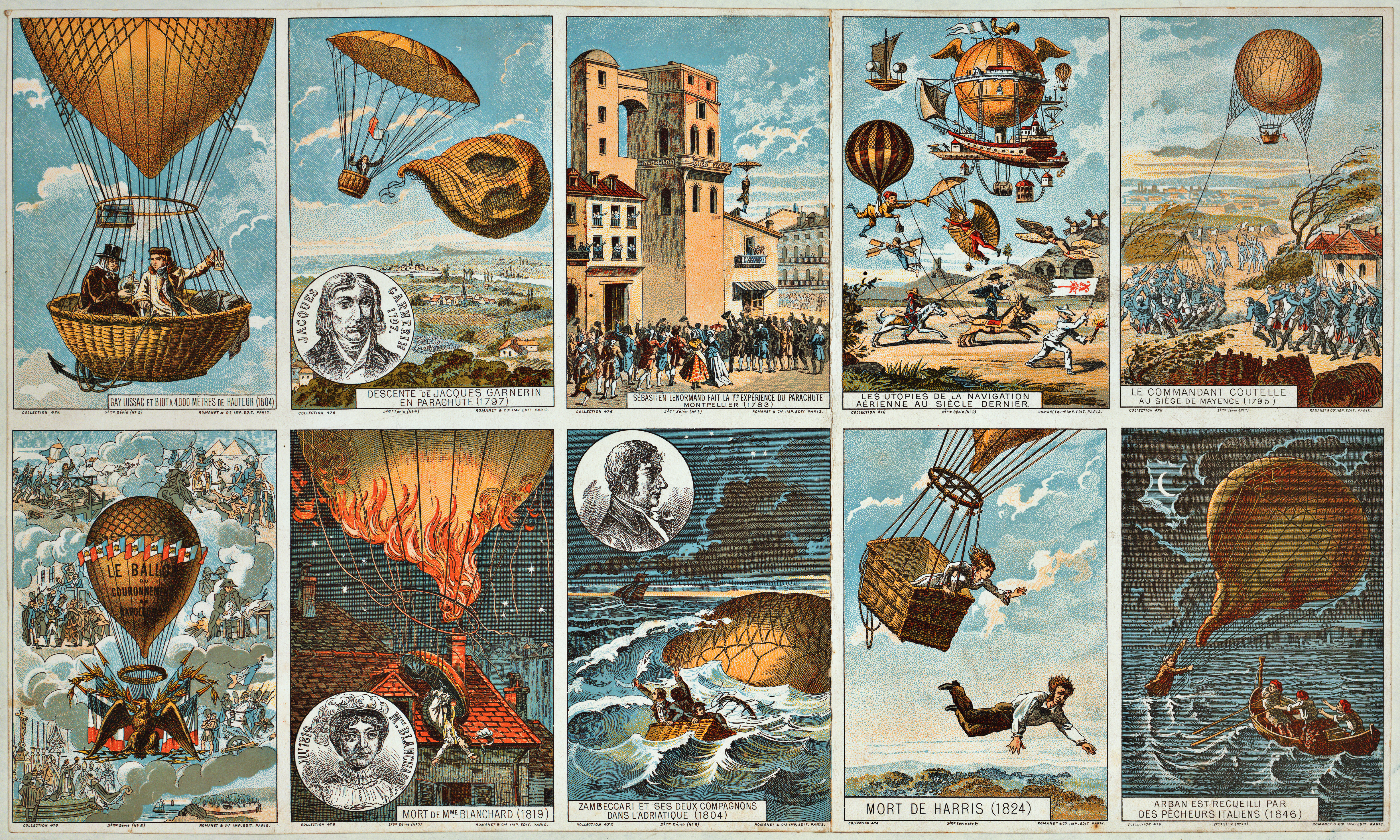
Of course the origins can be traced back to a few different places and the farthest back I found was from China. In China paper balloons were used for military signalling. Bt the first documented balloon science that I found was traced back to France in the 1700's. Each of the first flights were one part science, and one part spectacle with tens of thousands turning up to watch each flight.
One of the first scientific experiments done with a balloon was to fly a rooster, a duck, and a sheep. This was to determine if humans could indeed survive a balloon flight. The duck was a control as it was an animal known to be able to live at higher altitudes, the chicken was a control as it was also a bird, but a bird that doesn't fly, and the sheep represented a human as it's a larger mammal.
Soon after humans started flying and every one was trying to fly higher and longer distances. Eventually two brave men decided to try to cross the English channel. There is another interesting scientific/artistic experiment that tells this story (watch the video below).
Ballooning and science using balloons really took off during the romantic era where it was very common for art and science to overlap. Wordsworth wrote pomes about ballooning, beautiful artwork depicted the scientific experiments, and still today we have overlap. To one extreme we have the performance group AeroSphere using balloons. However we also have many of our data inspiring art work be it sprites (lightning strikes), or the Alien birds. I heard of, but can't find the link for a quilt designed off of one of the model runs of the magnetosphere that won a prize.
When art and science mix it's always exciting.
This week Robyn and I are at the Science working group meeting for the Van Allen Probes (being held in the Van Allen Hall at the University of Iowa). Hopefully we'll have some great things to share after this meeting. I'm trying to post a few updates on twitter so keep an eye out for little tidbits through out the week.
Enjoy
Tuesday, July 9, 2013
Rainbow over the building and CMEs
While we have our esteemed visitor here with us, we were hoping to get a roof top test done. The roof top test is where we put the payload up on the roof and test the batteries ability to charge off of solar cells as well as the solar cell connections. However this week (and the last few it seems) have been cloudy and rainy. Last night however when on my way home I looked back and saw a rainbow over the building... perhaps that is a sign that things are clearing up? Probably not, but it was pretty to look at.

The video that came up right afterwords was on Solar Flares and Coronal Mass Ejections (CMEs), something much closer to what we study with BARREL.
BARREL looks at some of the effects of CMEs and solar flares on our magnetosphere by looking indirectly for particle precipitation due to solar storms. One might compare our measurements to that of a rain gauge, just like a rain gauge estimates how much precipitation occurred during a thunderstorm, we're looking at how much precipitation occurred during a geomagnetic storm. However, instead of collecting rain drops, we collect x-rays which are a byproduct of electrons hitting our upper atmosphere. The x-ray counts are then a proxy for how many electrons precipitated into the atmosphere.

While looking for a good site that had information about rainbows I instead found a great video on fire rainbows by the weather channel.
Note: Sorry the link/embed code seems to be broken so it's not going to the fire rainbow video. I'll fix it ASAP (which really means once it's fixed on the weather channel site and I notice... if you Google weather channel and fire rainbows though it's one of the first ones and well worth a watch).
The video that came up right afterwords was on Solar Flares and Coronal Mass Ejections (CMEs), something much closer to what we study with BARREL.
BARREL looks at some of the effects of CMEs and solar flares on our magnetosphere by looking indirectly for particle precipitation due to solar storms. One might compare our measurements to that of a rain gauge, just like a rain gauge estimates how much precipitation occurred during a thunderstorm, we're looking at how much precipitation occurred during a geomagnetic storm. However, instead of collecting rain drops, we collect x-rays which are a byproduct of electrons hitting our upper atmosphere. The x-ray counts are then a proxy for how many electrons precipitated into the atmosphere.
Monday, July 8, 2013
Today's google Doodle
Today's google Doodle celebrates the 66th anniversary of the first Roswell sighting of a UFO. This UFO was a weather balloon with really cool out of this world science, but it was only as off worldly as the ionosphere. The project that these balloons were from was Skyhook and was from the Aeronautical research division of the General Mills company. Yes, the cereal company General Mills. Eagle Speak has a great article on Skyhook, and David Darling has a nice short explanation of the UFO sightings.
Enjoy!
Friday, July 5, 2013
Science telecoms are starting back up!
This Monday we will be starting our bi-weekly telecoms back up. This coming week Jan will be presenting on some of his modeling efforts to look at January 17th. It should be a great discussion. If you are not on the BARREL e-mail list and would like to be, please contact either Robyn or myself.
Have a great weekend
As a random bit of science, Jan before coming to Dartmouth modelled the magnetosphere of Mercury. Here is a picture of him looking very thoughtfully towards the sun in his simulation with Prof. Robert Rankin.

And because movies are always fun. Here is a movie of the their simulation.

Have a great weekend
Wednesday, April 24, 2013
SDO - Three years in 3 mins.
The NASA satellite Solar Dynamic Observatory (SDO) has put together a great movie showing the dynamics on the sun over a three year period - in three minutes.
There is an article at NPR accompanying this movie. I found a lot of the comments interesting. A common question that can up was does the sun spin or is the spinning due to the Earth? Yes, the Sun spins around it's own axis and is made up of hot ionised gas which we call plasma. Plasma acts kind of like a liquid, so different parts of the sun will rotate at different rates. Near the Sun's equator it rotates once ever 25 days or so while at the Sun's poles it's closer to 30 days. This is pretty impressive if you consider that it takes the Earth ~1/27 = 0.037 of a Sun's rotation to rotate and the Sun is ~109 Earth's across!
Although the sunspots, flares, brightenings on the Sun all appear to be in two belts, They actually go through what we call the Butterfly pattern. At the beginning of a solar cycle (11 year period) These regions are found closer to the poles. As time goes on they move towards the equator. This solar cycle is where the Sun's magnetic field reverses, so the south pole becomes the north and the north pole becomes the south. Our magnetic field also does this, but on a much longer time scale.
The Sun is incredibly interesting and so important to life here on Earth. There are quiet a few great missions which focus on studying the Sun. If you want to check out more wonderful photos and videos search for SOHO and STEREO. STEREO is actually two satellites looking at the Sun in stereo allowing us to get some amazing 3-D images of the Sun! One of the Satellites is trailing us in our orbit while the other is running ahead of us. At the moment they are situated so that we can actually see what is going on behind the Sun as well for the first time!
Enjoy,
There is an article at NPR accompanying this movie. I found a lot of the comments interesting. A common question that can up was does the sun spin or is the spinning due to the Earth? Yes, the Sun spins around it's own axis and is made up of hot ionised gas which we call plasma. Plasma acts kind of like a liquid, so different parts of the sun will rotate at different rates. Near the Sun's equator it rotates once ever 25 days or so while at the Sun's poles it's closer to 30 days. This is pretty impressive if you consider that it takes the Earth ~1/27 = 0.037 of a Sun's rotation to rotate and the Sun is ~109 Earth's across!
Although the sunspots, flares, brightenings on the Sun all appear to be in two belts, They actually go through what we call the Butterfly pattern. At the beginning of a solar cycle (11 year period) These regions are found closer to the poles. As time goes on they move towards the equator. This solar cycle is where the Sun's magnetic field reverses, so the south pole becomes the north and the north pole becomes the south. Our magnetic field also does this, but on a much longer time scale.
The Sun is incredibly interesting and so important to life here on Earth. There are quiet a few great missions which focus on studying the Sun. If you want to check out more wonderful photos and videos search for SOHO and STEREO. STEREO is actually two satellites looking at the Sun in stereo allowing us to get some amazing 3-D images of the Sun! One of the Satellites is trailing us in our orbit while the other is running ahead of us. At the moment they are situated so that we can actually see what is going on behind the Sun as well for the first time!
Enjoy,
Monday, April 22, 2013
Robyn's Physics Colloquium video
As promised, here is Robyn's physics colloquium talk! It really was fun to see our entire campaign summarised with a great introduction. If you've ever wondered what it is we do exactly or what space physics even is, this has some great info at the beginning.
Colloquium Abstract - April 19, 2013
Robyn Millan, Dartmouth College
Topic: "Dynamics of Radiation Belt Electrons and the BARREL Experiment"
Abstract: The intensity of relativistic electrons in Earth's radiation belts is known to be highly variable, but the processes responsible for this variability are still not well understood. Observed rapid depletions and subsequent rebuilding of the trapped particle population imply an efficient energization process, in some cases accelerating electrons to multiple MeV energies on a timescale as short as minutes. NASA's two Van Allen Probes were launched in August 2012 to study the radiation belts. BARREL is a multiple-balloon investigation that works with the Van Allen Probes to study atmospheric loss of radiation belt electrons. The first BARREL balloon campaign was carried out in January-February 2013. Twenty small (~20 kg) balloon payloads were launched from the SANAE IV and Halley VI Antarctic research stations. A second campaign will be carried out next year. This talk will provide an introduction to radiation belt physics, and will summarize early results from BARREL and Van Allen.
I'll see if we can get the actual video to upload here, but in the mean time, just click on the link.
GOES-R Movie Trailer
A New GOES Satellite is on it's way and not too soon either.
We use the GOES satellites and their data a lot! They provided some great data to help us forecast space weather during this last campaign. We were able to confirm that we saw an x-ray flare from the sun with our balloons due to GOES. We were able to see waves and their associated plasma parameters which may be the cause for some of our observed precipitation, and the list goes on. This is great news that we'll be getting a new GOES satellite in a few years!
We use the GOES satellites and their data a lot! They provided some great data to help us forecast space weather during this last campaign. We were able to confirm that we saw an x-ray flare from the sun with our balloons due to GOES. We were able to see waves and their associated plasma parameters which may be the cause for some of our observed precipitation, and the list goes on. This is great news that we'll be getting a new GOES satellite in a few years!
Tuesday, April 16, 2013
Reflections on Becoming the Science Communicator. Part three (and the scariest) Video

The final reflection. - video.
The video section was perhaps the most useful and the most embarrassing. It's amazing today how easy it is to make a video. If you've been following our blog you've seen a few of my attempts already. However at the meeting we got some great tips on how to make them look much more professional... with only the use of a phone or flip cam. Once again the layout was the same. Have a strong message with three pillars to really hold it up. Once you've got your message and structure you also need a call to action and of course some visual support. I found it interesting how this call to action was really related to letting your audience in, making them feel that they have a stake in this to and can do something about it.
All of these public out reach forums are things that as a scientist one never thinks they are going to do. One does not go into science to start a blog or become a celebrity and talk with news outlets, but it is something that I'm finding is really important. We become scientist, for the most part, because we love to figure things out and want to understand the world around us. But it is so important for us to also be able to show and communicate our results to the larger community. I suppose that means that at least to a certain degree I better get use to hearing my own voice or seeing myself in a video.
In the task given to us we were asked to film our message in three shots, an opening statement in a wide shot, our three main points in a tight shot, and then our closing statement in a wide shot. As you can see we didn't quiet make that.
The opening statement was suppose to pull the audience in. Thus my attempt at a funny story about how space weather gave me a snow day in school for at least one class. And that's where I then started to realise I was running out of time (we had less than 2 mins to talk). The next section was suppose to really convey concisely (not a strong point for me) what we wanted people to take away from the video. And in the closing statement, instead of rushing to a result, one is suppose to restate your message and "galvanise" your audience.
Here is my attempt. (If you notice I also took the time to add some "B-roll" of the flights of our payloads.)
And because I made you all sit and listen to me, here is a wonderful lecture about some early astrophysics ballooning by perhaps the best physics educator ever Prof. Walter Lewin. Thank you stratocat for pointing me to this clip.
Wednesday, April 10, 2013
Becoming a science communicator.
Today I (Alexa) am attending an NSF EPSCoR workshop on science communication. Hopefully I'll learn some really cool tricks and be able to improve this blog to make it even more awesome. Thus far today we've learned about twitter, and how about why many science communications fail. It's been really interesting and I hope to learn a lot more. In the mean time, this gives me an excuse to show two videos of my favourite science communicators. Bill Nye the Science guy and Neil deGrasse Tyson. I hope you enjoy!
Wednesday, April 3, 2013
The ISS
Over the last few weeks I've seen a few great reports on the International Space Station (ISS). The first one is from the Atlantic. They have 40 photos from the ISS. I can't believe that it's been up and manned for over 13 years. It seems like just yesterday they were starting to build it.
Here is a great video of sounds from space with video from the ISS.
The other report is a wonderful movie about an astro photographer filled with beautiful photos. Some of them are time lapsed so that you can see things like the movement of the Aurora. It's spectacular. Enjoy!
If anyone is looking for an astrophotographer to send into space, I'm sure I can make some room in my schedule.
Here is a great video of sounds from space with video from the ISS.
The other report is a wonderful movie about an astro photographer filled with beautiful photos. Some of them are time lapsed so that you can see things like the movement of the Aurora. It's spectacular. Enjoy!
If anyone is looking for an astrophotographer to send into space, I'm sure I can make some room in my schedule.
Monday, April 1, 2013
Rapping science in schools
This is just a neat idea so I wanted to share.
So, the big question... Does anyone out there have a rap about heliospheric physics? Auroras? Solar storms? Balloons? If so, you should send it to us and we'll feature it in a post. A few rules; 1) It must be family friendly 2) it must be accurate and 3) it must be Awesome and/or nerdy. One of my friends did make a mix from our graduate Electromagnetism lectures. It's not space physics, but E&M is a huge part of what we do. If I can find it I promise to share it.
So, the big question... Does anyone out there have a rap about heliospheric physics? Auroras? Solar storms? Balloons? If so, you should send it to us and we'll feature it in a post. A few rules; 1) It must be family friendly 2) it must be accurate and 3) it must be Awesome and/or nerdy. One of my friends did make a mix from our graduate Electromagnetism lectures. It's not space physics, but E&M is a huge part of what we do. If I can find it I promise to share it.
Subscribe to:
Posts (Atom)